

To give students the opportunity to present the games they’ve developed themselves to a large audience—with this idea in mind, Prof. Dr. Greta Hoffmann of Cologne Game Lab (CGL) launched RAW TALENT in 2024. In this interview, she explains why the idea has resonated internationally, what matters most to her, and how the format is set to evolve.
RAW TALENT is a joint booth for student-developed games at gamescom. In 2024, the initiative—launched by Prof. Dr. Greta Hoffmann—kicked off with three universities and about 18 games in a four-square-meter space. In 2026, more than 380 students from 18 public universities across five countries will present over 90 games in an 81-square-meter space.
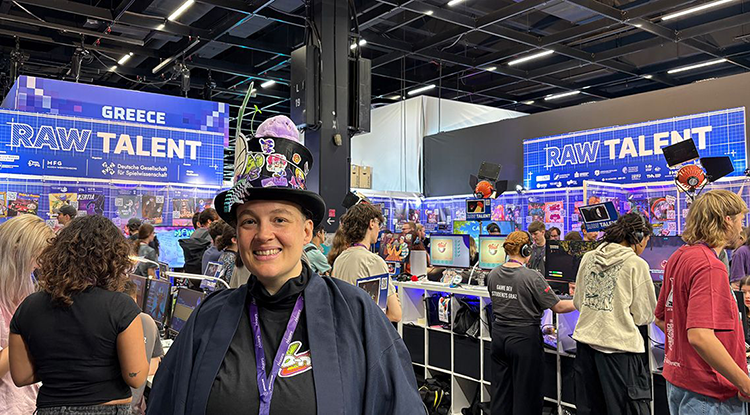
Prof. Dr. Greta Hoffmann from the Cologne Game Lab at the RAW TALENT booth at gamescom 2026. (Photo: TH Köln)
How did the idea for RAW TALENT come about?
When I joined CGL, I noticed that the students were developing great games but rarely shared them with the outside world. Yet, when starting a career, it’s important to gain experience in publishing and exhibiting, in addition to development. That’s why we first founded the student publishing label Broken Paternoster Games together with the students. This quickly led to the question: What’s the biggest opportunity we could offer the teams? For me, that was gamescom—and not just the Business Area, but the place where a broad audience can actually try out the games: the Indie Area. The idea that our students might one day present their own games there was, at first, just a dream. Then we started thinking about how we could make it happen.
Why did the idea resonate so strongly with other universities as well?
After the first year, it quickly became clear that we weren’t alone in this dream. Students who develop games want to showcase their work, and faculty at other universities want to give them that same opportunity. At the same time, we had proven that such a joint presentation is feasible even with limited financial resources. After that, more and more universities joined in. To me, the fact that RAW TALENT has grown so much shows above all just how great the desire for such opportunities is. But this can only work because Me
How does the fact that students from five countries are now exhibiting together change things?
The gaming community has always been international. The fact that universities from five countries are now represented together at RAW TALENT makes that clear right at the booth. I think this international exchange is especially important for young people: they see what students from other countries are working on, strike up conversations with one another, and realize at the same time that they often share very similar goals. What I find particularly valuable are the encounters that can’t be planned at all. Sometimes you meet someone by chance at events like this and only realize years later what an impact that encounter had on your own path. RAW TALENT creates a space where exactly these kinds of connections can form.
What makes you particularly proud after three years of RAW TALENT?
I have a bit of a hard time with the term “pride” because RAW TALENT is supported by so many people today, and much of what happens here isn’t even my doing. What I am proud of, however, is that we cleared the first hurdle and got the ball rolling. I may have sparked the flame, but the fire is now being carried forward by many others. It means a great deal to me that students from Germany—and now also from other European countries—can have an experience through this that I myself would have wished for back then. That’s exactly where I see
How should RAW TALENT continue to develop in the coming years?
My goal isn’t for RAW TALENT to grow as much as possible every year. What’s more important is to ensure the program’s long-term sustainability and to develop it in a healthy way. At the same time, I’d like to see it become even more European in scope. This also applies to universities that may want to participate but lack the staff resources to organize it. In the medium term, we need to consider how we can enable these students to participate as well. My long-term goal is for as many game design students in Europe as possible to have the opportunity to present their work in such a setting at least once during their studies.
August 2026, interview done by Marcel Hönighausen (TH Köln)