


Summer 2007. Katharina Tillmanns onstage at Cologne’s Cinenova cinema during the introduction of her graduation film by Film and Media Studies professor Gundolf S. Freyermuth. Credits: ifs internationale filmschule köln
This post is by Dr. Katharina Tillmanns, researcher, experience designer, and lecturer at the Cologne Game Lab, TH Köln. She first met Prof. Em. Dr. Gundolf S. Freyermuth in 2004 as one of his first students at the ifs International Film School Cologne. Over the following twenty-two years, their relationship evolved through many roles, eventually culminating in Gundolf S. Freyermuth supervising her doctoral research. In the contribution below, Katharina Tillmanns reflects on this long academic companionship and the formative influence it had on her own path as a researcher and creative practitioner.
Check out her contribution below:
An Origin Story
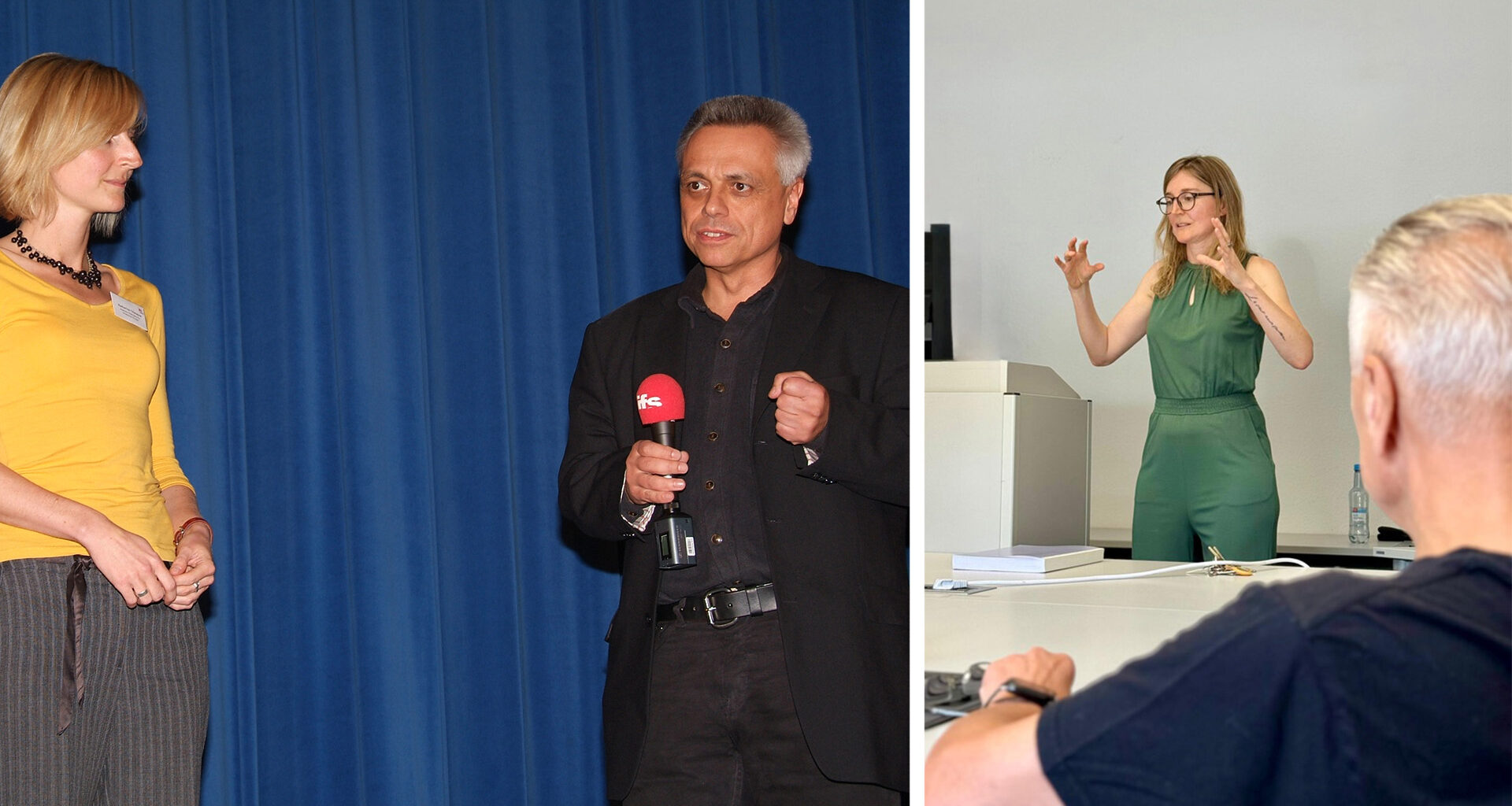
left: Credits: ifs internationale filmschule köln | right: Credits: Tobias Wolter
Exhibit A. It is the summer of 2007. I am standing on the stage of Cologne’s Cinenova cinema. Beside me, my professor for Film and Media Studies, Gundolf S. Freyermuth, is introducing my graduation film to the audience—with considerable theatrical enthusiasm.
Exhibit B. Summer 2026. I am defending my doctoral thesis on a body-based design method for Mixed Reality. Gundolf is now part of my doctoral committee.
Seeing pictures from my presentation afterward—and thinking back to my very first impression of Gundolf twenty-two years earlier—I noticed something unexpected.
We occupy a room in remarkably similar ways.
Not in our opinions.
Not in our research.
In the way we address an audience, and even more so in the way we think aloud. In the way our thoughts unfold through gesture, movement, and presence …
In German academia, we have the terms Doktorvater and Doktormutter—literally “doctoral father” and “doctoral mother”—to describe the ideal relationship between a doctoral supervisor and their candidate. The terminology itself acknowledges that academic formation extends beyond supervision. As doctoral candidates, we develop ways of seeing through dialogue with those who shape us: perspectives on the subject of our research, on the wider cultural and historical contexts in which it is embedded, and even on ourselves and others. These ways of seeing emerge over years of conversation, intellectual challenge, and shared curiosity, and oftentimes joint project work.
Now imagine such a relationship unfolding over twenty-two years—roughly half of a lifetime—as mine has with Gundolf S. Freyermuth. At that point, Doktorvater no longer seems quite sufficient. Another German expression comes to mind. Although it is not an established academic title, it feels far more accurate in my case: akademischer Ziehvater—my academic father in the fullest sense of the term.
Over more than two decades, Gundolf has been witness, mentor, and—sometimes loudly, sometimes quietly—an unwavering supporter of my coming of age as an academic, as a creative practitioner, and, quite frankly, as a human being.
Our story began in the winter term of 2004.
I had just left a media studies program in Bochum rather disillusioned and started studying Film Directing at the ifs International Film School Cologne. I was excited about making films, but considerably less enthusiastic about what “film studies” seemed to promise. The film history lectures at ifs were undoubtedly rigorous, yet offered little cultural context or relevance to my idea of filmmaking. They were delivered in a rather traditional manner that could send even the most motivated film student into a coma within minutes.
Then Gundolf arrived.
Freshly appointed Professor of Film and Media Studies, he opened the semester with an inaugural lecture titled The Happy End of Authenticity: Cultural Consequences of Media Digitalization for the Audiovisual Arts. The session felt as though someone had suddenly opened the windows.
Part of what captivated me was the clarity of Gundolf’s thinking. His arguments unfolded with remarkable precision, connecting media history, cultural developments, and technological change without ever losing sight of why any of it mattered to people who actually wanted to make films. Theory was never presented as an abstract body of knowledge but as something that illuminated my own creative practice and those of my fellow students. Only much later did I realize why this resonated so deeply with me. Even then, I instinctively approached theory from practice rather than the other way around. I was never interested in ideas in isolation; I wanted to understand how they could give rise to stories, worlds, and experiences through which people make meaning together. Looking back, I realize that this way of thinking would quietly become the defining rhythm of my own—rather accidental—academic path.
The other, even more compelling part was that this new professor was not the archetypal German media studies scholar but something closer to a gum-chewing cowboy in an Australian outback coat who, with unmistakably American confidence and an expansive physical presence, sketched the future of our medium with words and gesture. Gundolf had only recently returned from his ranch in Arizona, from years as a Hollywood and technology reporter, from writing novels—worlds that seem almost incompatible with the media scholar until you meet him and realize they somehow form a remarkably coherent whole.
I belonged to Gundolf’s first cohort at the ifs. He was teaching a room full of aspiring filmmakers who, if we are being honest, would usually have preferred to be on set rather than in a media studies seminar. Gundolf understood that instinct immediately. Rather than asking us to leave our creative interests at the classroom door, he insisted on connecting theory directly to practice. How did the questions we encountered while making films relate to larger developments in media history? What could understanding the past tell us about the future of our medium? Looking back, I realize that this future-oriented perspective was perhaps his greatest gift. He encouraged us not only to understand the media landscape we had inherited, but to imagine the one we were about to shape.
His seminars soon became legendary for the sheer density of names, historical events, technological developments, and anecdotes they contained. Whether he was speaking about nineteenth-century inventions or emerging digital cultures, he did so with such immediacy that one could almost believe he had witnessed them firsthand. His oral exams, meanwhile, acquired an almost mythical reputation among students. Even years later, I would occasionally meet students who would lower their voices conspiratorially and say, “I’ve got my oral exam with Gundolf today,” as though announcing an audience with a particularly demanding—but ultimately fair—oracle.
My time at the ifs came to an end in 2007. Gundolf’s professorship there, by contrast, would continue for many years. During that time, the Australian outback coat gradually gave way to the all-black wardrobe that has since become something of a trademark—although, for the record, I still maintain that the blue he occasionally sports nowadays suits him remarkably well.
What never changed was Gundolf’s willingness—perhaps even his delight—in standing out. Gundolf possesses a strong creative impulse to reshape things that simply do not make sense. Whether ideas, institutions, curricula, or established ways of thinking, Gundolf has never accepted structures merely because they existed. If something can be reimagined, he reimagines it. If it can be improved, he sets about improving it.
Years later, by a series of fortunate coincidences, I found myself joining the newly founded Cologne Game Lab in a position that combined public relations, research acquisition, and—like any startup institute—pretty much everything else.
My introduction to the hiring process, however, was memorable for entirely different reasons. In my first interview, I met only Björn Bartholdy. At one point, he casually mentioned his co-director, Gundolf S. Freyermuth. I nodded knowingly, doing my very best to appear perfectly informed, while drama unfolded inside. Until that very moment, I had been completely oblivious to the fact that Gundolf was involved in the Cologne Game Lab—let alone that he was one of its founders.
Barely had I left the meeting when my phone rang.
It was Gundolf.
He wanted to know whether I had ever intended to tell him that I was applying for a position at his institute.
To this day, I am still not entirely sure whether his tone was reproachful, mischievous, or both. Both, I suspect, would have been entirely justified.
Eventually, Gundolf did become one of my bosses, and together with Björn Bartholdy and a small team armed with far more enthusiasm than resources—but fortunately no shortage of vision—we set about building the Cologne Game Lab. Among our earliest adventures was launching the institute’s first M.A. program, Game Development & Research. Soon afterward, I enrolled in its second cohort, once again finding myself in Gundolf’s media studies classes.
After graduating in 2013, I began acquiring my own research funding, leading projects as principal investigator, and gradually shaping my own research profile. Time and again, I would develop a vision for a change of role at the Cologne Game Lab, a creative project, or other endeavor, only to discover that it somehow resonated with ideas Gundolf had quietly been cultivating in the background all along.
Eventually, Gundolf introduced me to Benjamin Beil at the University of Cologne, where I embarked on my PhD under their joint supervision.
Coming to a doctoral thesis was anything but straightforward. It wasn’t that I doubted my ability to investigate or create knowledge. Quite the opposite. By then, I had already spent years developing projects, leading research, and presenting my work internationally. What I struggled with was a very particular image of what an academic was supposed to be: someone whose primary medium was the written word, who delighted in tracing theoretical genealogies and filling every paragraph with references.
My own investigations had always begun elsewhere—in practice, in design, in making things, and only then in asking what they had taught me. Writing had never been the destination. It had always been a way of bringing something else into existence: a theatre performance, a film, a game, an experience. Simply sitting down to write therefore held nowhere near the intrinsic appeal it seemed to hold for Gundolf. Watching him happily disappear into what looked like months of uninterrupted reading and writing during his sabbatical, I remember inwardly rolling my eyes more than once—only to feel slightly guilty about my own inability to share either his enthusiasm or his apparent ease. Hello, academic puberty.
At the same time, my research was gradually moving away from Gundolf’s own center of gravity. While his work had profoundly shaped my understanding of audiovisual media and the cultural narratives surrounding technology, my attention increasingly shifted toward the body itself. I became fascinated by how meaning emerges through posture, movement, breath, and bodily sensation in immersive worlds—sometimes even before audiovisual representation enters the picture.
Only once I had stopped trying to write like the media scholar I thought I was expected to become did writing become genuinely enjoyable. Somewhere along the way, academic prose had begun to meet my own voice halfway. Or perhaps I had quietly persuaded it to.
The thesis eventually found its way into the world— much later than originally planned. By the time I finally submitted it, Gundolf had already been emeritus for more than a year, happily back on his ranch in Arizona, living what I had always imagined to be every author’s dream: writing because writing itself was reason enough.
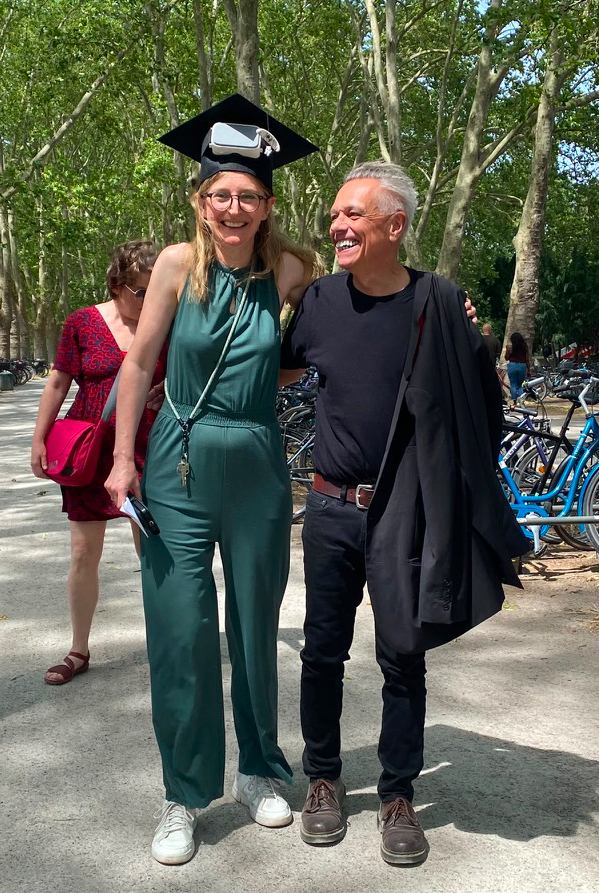
And yet, when the day of my doctoral defense arrived, Gundolf was there.
The dissertation he had accompanied was, unsurprisingly, not an entirely conventional one. It wandered between theory and autobiography, between scholarly argument and lived experience. Somewhere along the way, I had bent academic writing to meet me rather than the other way around. Then again, perhaps this should not have surprised me. Over the years, I had watched Gundolf question conventions simply because they were conventions. If a structure no longer made sense, he redesigned it. If a form no longer served its purpose, he changed it.
Somewhere along the way, I had apparently developed the same instinct. My dissertation was simply the first place it found expression on such a scale.
by Katharina Tillmanns
Photo: Summer 2026. Katharina Tillmanns arm in arm with Gundolf in the campus park at the University of Cologne after the successful defense of her PhD dissertation. Credits: Tobias Wolter