

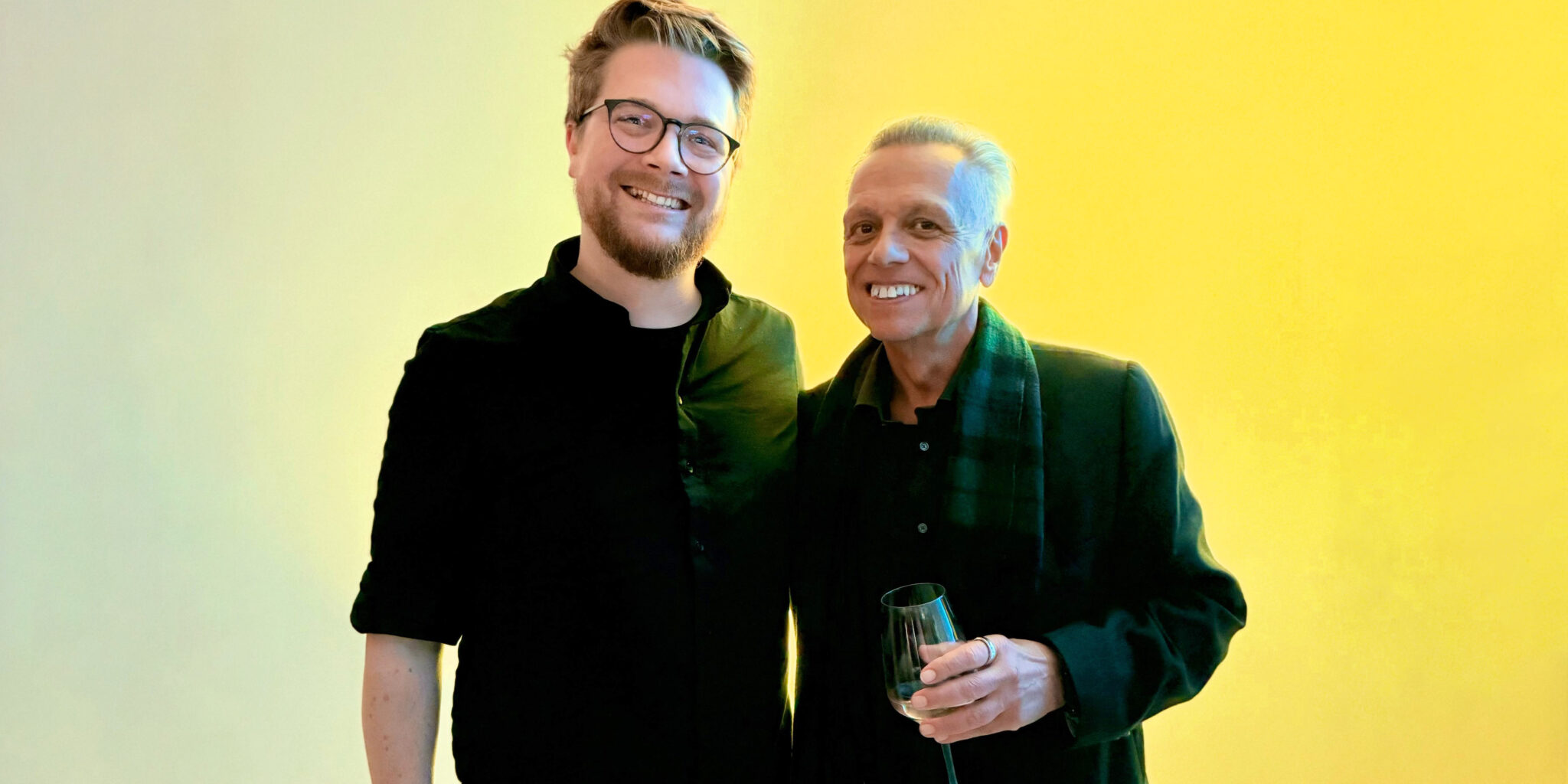
Jonas Zimmer with Gundolf S. Freyermuth, in the Reception event following Gundolf S. Freyermuth’s closing keynote “Playing the Future – in War and Peace” at the Transformations Conference, held at the Cologne Game Lab, on 25 September 2025. Credits: Guido Löhrer.
This post is by Dr. Jonas Zimmer, Professor of Game Informatics at the Cologne Game Lab. Jonas Zimmer joined the institute as a researcher in 2017 and later completed his PhD under the supervision of Prof. Em. Dr. Gundolf S. Freyermuth. In his contribution, he reflects on the past ten years, his journey from game developer to professor, and the lasting influence Gundolf S. Freyermuth has had on his understanding of research, teaching, and mentorship.
Check out his contribution below:
Doktorvater
I first met Gundolf ten years ago, virtually, in a Skype call. It was November 2016, and I had spent a short and rather uncomfortable night sleeping on the floor of the NRW-Forum in Düsseldorf. I was taking part in the Ubisoft Game Jam during the Next Level Conference. For the call, I found myself a quiet spot in a cobwebbed corner of the basement, away from the conference noise. The call, however, had nothing to do with the conference. A few days earlier, I had decided to leave my job as a developer at a serious games company to pursue a PhD at CGL. Before I could start, Gundolf wanted to get to know his potential new colleague.
I had prepared myself for a conventional job interview. Gundolf, however, seemed more interested in philosophising with me. About what, I unfortunately can’t remember. It certainly wasn’t all that technical. And despite being tired and probably a bit grumpy, I apparently managed to convince him. In January 2017, I started working as a developer in the Cologne Game Lab’s research department, tinkering with mixed reality projects.
Around that time, I also began teaching a few courses in the bachelor’s programme. Something clicked immediately. I genuinely enjoyed teaching. I still remember rather confidently telling some of my friends who worked as schoolteachers how much more practical teaching at a university was. After all, everyone there is an adult. I could focus entirely on sharing knowledge without having to worry about pedagogy.
How naive I was.
At the time, I was still trying to find my feet as a researcher, too. Alongside my work at the lab, I had begun writing my PhD proposal. As a young researcher, figuring out what you want to focus on isn’t easy. You find yourself floating in a vacuum of possibilities, wanting to do everything at once but struggling to find something to hold on to. Eventually, I settled on what I thought was a brilliant idea (it wasn’t), put it on paper, and presented it to Gundolf. He agreed to supervise my dissertation. What I didn’t know at the time was that another six years would pass before my dissertation was finally finished and ready to gather dust on my bookshelf. And that by then, it would bear absolutely no resemblance to my original proposal. Thankfully.
Ten years after that first Skype call, I now find myself sitting in Gundolf’s former office, writing these lines. I’ve become a professor myself. It’s a job I genuinely enjoy, and I’m grateful to be here. Although sometimes I still wonder how it all happened. How that naive, enthusiastic young researcher somehow ended up becoming a professor.
I certainly didn’t get here on my own. Gundolf did more than simply supervise me. He guided me. He challenged me to question my original ideas and throw them out altogether. He pushed me to dig deeper, to become more specific. In our conversations, he would repeatedly draw me into little academic debates, challenging me to defend my positions and, in doing so, reconsider them myself. He supported me, recommended me to colleagues, and helped me secure further projects that eventually formed the foundation of my doctoral research. But he was also understanding and empathetic during personal crises, giving me the space I needed to work through them.
Gundolf helped me find my own way. My place in this world. Today, I try to do the same. For my students as a professor. And for my daughter as a father.
In German, we call our PhD supervisor our Doktorvater. I remember always finding the term rather peculiar. An old-fashioned expression, a relic of academic hierarchies. But today, I see that there is something inherently paternal about being a professor. It’s not simply about passing on knowledge. We guide young people as they find their own place in this world. We give them the space to explore, try new things, and make mistakes. We challenge them and support them along the way.
I now understand why we call it Doktorvater.
And I learned that from you, Gundolf. Thank you.
Jonas Zimmer