
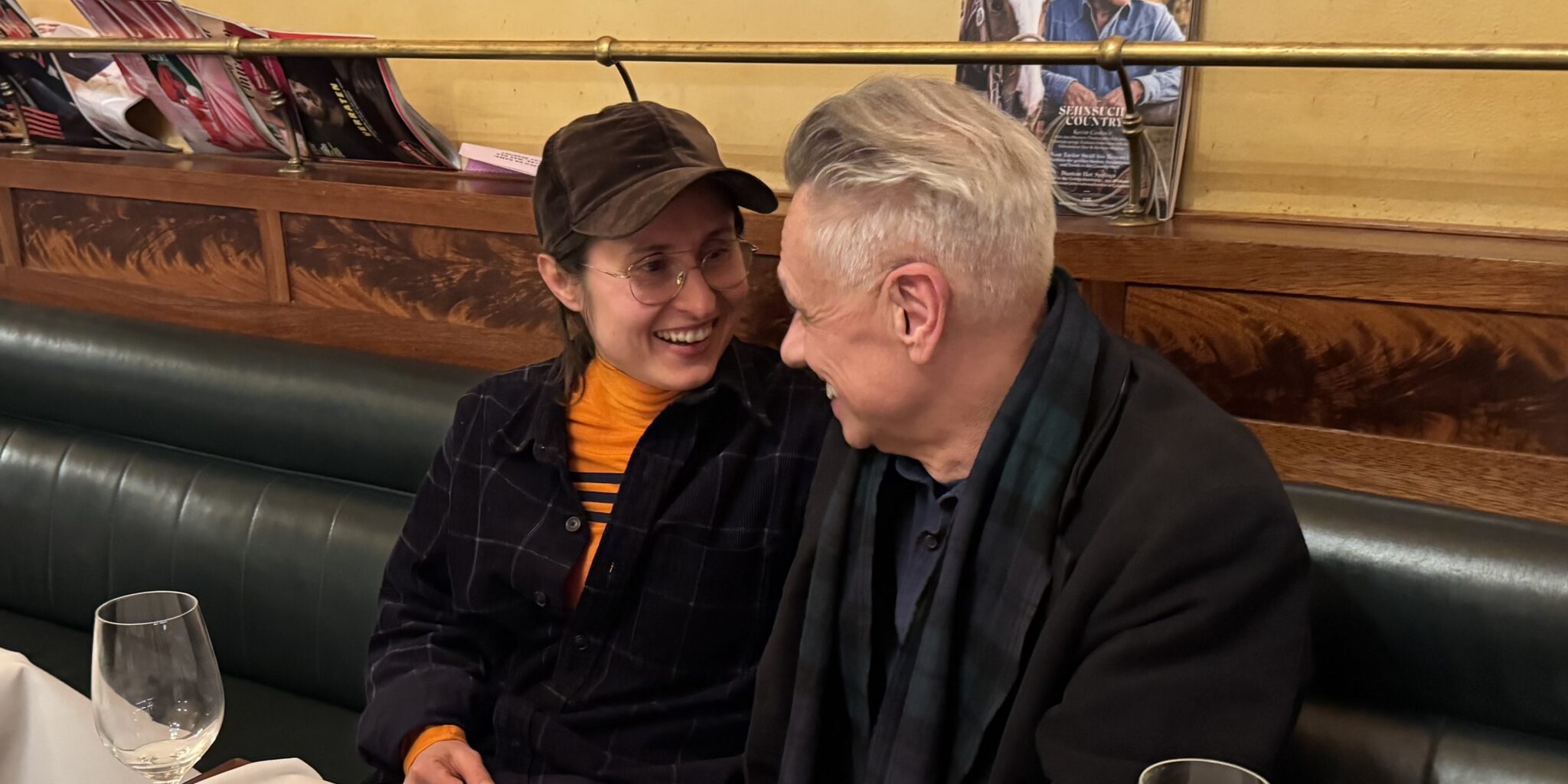
Sonia Fizek with Gundolf S. Freyermuth in March 2025, enjoying a good media historical conversation over lunch in one of West Berlin’s Cafes. Credits: unknown.
Gundolf S. Freyermuth as a Ludovisionary[1]
This post is by Prof Dr. Sonia Fizek, who worked with Prof. Em. Dr. Gundolf S. Freyermuth at Cologne Game Lab between the years 2020 and 2025 as the “sparring” professor in Media & Game Studies. Since then she has been holding the Game Studies post at CGL, where she is also a member of the Executive Board. Sonia Fizek is a media and game studies scholar and an educator with over eighteen years of experience across diverse academic systems, in the UK, Poland and Germany. Her current research concentrates on the media environmental sustainability of digital media, video games and their development.
Check out her contribution below:
Gundolf S. Freyermuth as a Ludovisionary[1]
It is quite a task to try to give tribute to a writer, journalist and scholar so prolific as Gundolf S. Freyermuth. Early in his writing career, Gundolf was an editor for the TransAtlantik, and later a reporter for stern and Tempo in the US, a fiction author and most of all, a curious and sharp observer of the audiovisual media landscape; one that left the known world of West Berlin and arrived at the very heart of the new world’s film industry—in the land of yellow poppies and towering sequoias. In California of the 1980s and 1990s, it seemed, only sky was the limit. Perhaps, the same may be said about Gundolf’s literary output decades later. How far would a pile of his books and articles stretch? Or perhaps, it is better to forget the codex and think more horizontally patching his works onto a pre-Roman scroll. Either way, to be able to read all his contributions and present a coherent portrait, one would need months if not years of close study.
Gundolf is a true storyteller. One that puts a scholar’s hat on and follows the stories and histories and the visionaries behind those. His writings, whether biographies or academic books and articles are histories of audiovisual media. The latest of all the modern media that have preoccupied him in the last few years are simulations and possible worlds propelled by the electronic digital computer (video games to put it blunt). The co-founding of the Cologne Game Lab: The Institute of Game Development & Research in 2010, an act that began on paper too, belongs to the broader vision of media-historical inquiry of the new medium on the one hand, and literally building its future within an academic landscape, on the other.
Gundolf and I first met in the summer of 2018 during the 11th Digital Games Research Association Conference at the University of Turin. There he presented Cologne Game Lab to the wider international game scholars’ community in the panel on large research units in game studies. My curiosity was sparked. Only time would tell how pivotal that encounter turned out to be for me (and I can only hope, a tiny bit for Gundolf and CGL). In its aftermath, two years later, I decided to apply for the professorship at CGL and move from Scotland back to Germany.
Almost a decade has passed since DiGRA 2018. CGL is still one of very few research institutes on the German, European and worldwide map. It is only in 2025 that the Association for Game Studies in Germany was founded. Game Studies professorships are few and far between. A lot remains to be done for the field within rigid university structures relying on established disciplines. Cologne Game Lab has made its name not only as the place to be for aspiring game designers and developers. More importantly, it has served as an early outpost for the humanities-led education and research on games, to a large degree thanks to Gundolf’s ludovisionary intuition.
Our first professional encounter developed into many collaborations and exchanges, at CGL and beyond. I am very glad to have been able to publish one of Gundolf’s texts on “Film and games as alter egos: Towards a media theory of audio-visual play” in the Journal of Gaming & Virtual Worlds, of which I was a co-editor-in-chief until 2024. As we both lived in Berlin, embodying the not-so-rare species of academic commuters, we would meet every now and then, often in spots where Gundolf was a regular guest. Our conversations, of which not enough had taken place (leaving us, dear Gundolf with hopefully many more to follow) always left me wondering weeks after our exchanges had taken place. Such moments are not everyday bread in a scholar’s life, mostly eaten up by bureaucracy, the so-called deliverables and tons of e-mails to adhere to. The more I tend to cherish our discussions, which always sprout new thoughts. A life argument opens spaces of possibilities. A dialogue creates meanings and leaves long-lasting impressions. It is those impressions that I hope to slalom through in the coming years of teaching and writing, allowing others to be exposed to some of Gundolf’s most foundational media theoretical and historical interpretations. To be able to truly understand any medium, one needs a critical distance—a vision which spans across time and space; a ludic television of sorts. I am awaiting with anticipation Gundolf’s magnum opus on theory and history of digital games, for his professorial role at CGL may have been put to rest, but his pen remains very much in motion.
Sonia Fizek
[1] In 2024 Gundolf published a book Wer War WM? Auf den Spüren eines Televisionärs: Wolfgang Menges Leben und Werk, a history of television as seen through the biography of a televisionary and his friend Wolfgang Menge. If WM was a televisionary, then perhaps by playful analogy, we could refer to Gundolf S. Freyermuth as a ludovisionary. Why? His visions span beyond theories of video games. As a co-founder of the first institute that offers game education and research within the German academia, he summoned a life organism and in it, in the tradition of European film schools, he settled game studies, an interdisciplinary field, which until today has found next to no institutional home in the German, European and worldwide academic systems.