
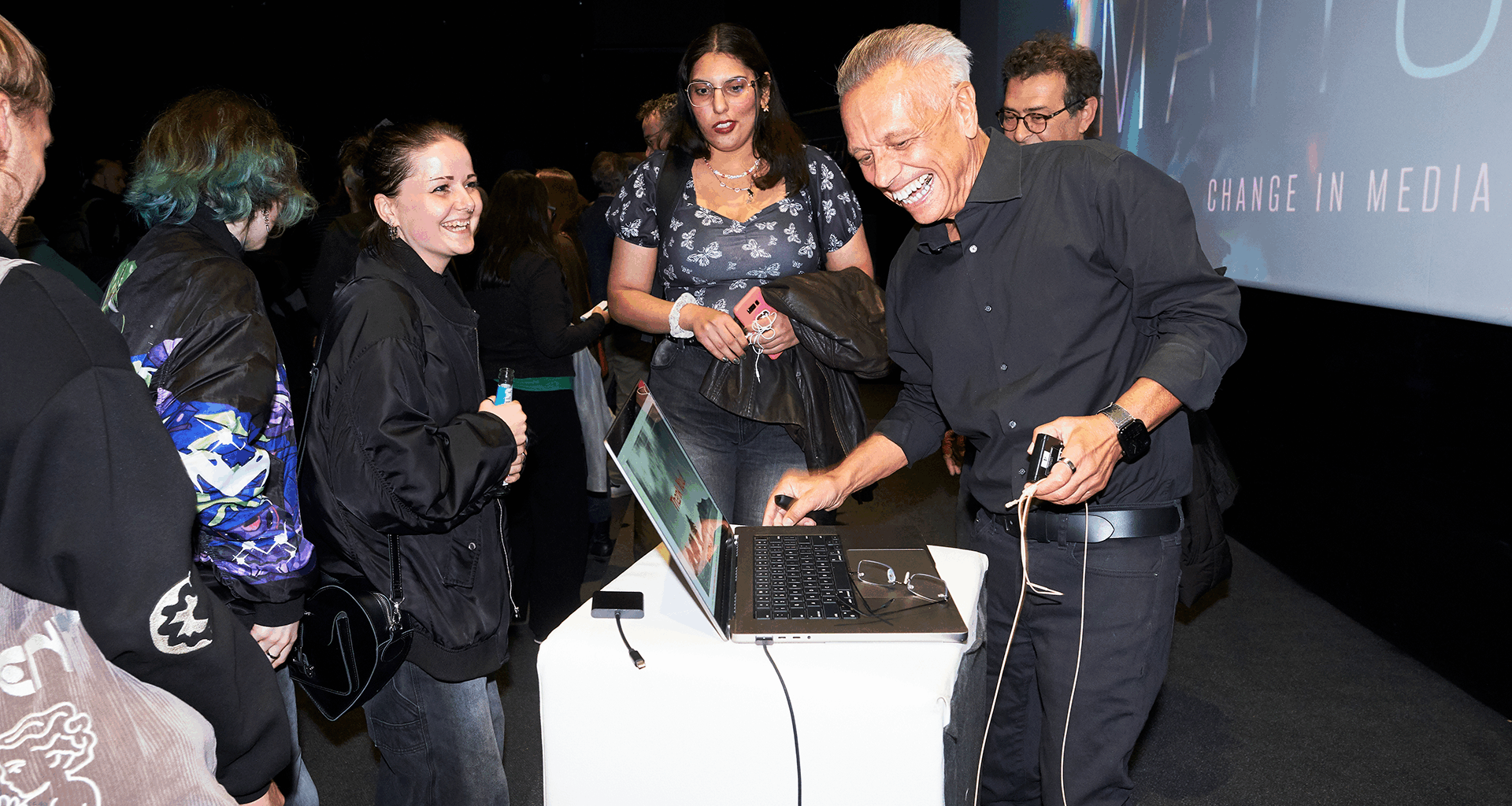
Isabel Grünberg with Gundolf S. Freyermuth, sharing a joke at the end of Gundolf S. Freyermuth’s closing keynote “Playing the Future – in War and Peace” at the Transformations Conference, held at the Cologne Game Lab, on 25 September 2025. Credits: Guido Löhrer.
Gundolf S. Freyermuth – The Legend of the Cologne Game Lab
This post was written by Isabel Grünberg, an alumna of the Cologne Game Lab, where she studied from 2019 to 2023. During her time as a student, she quickly developed a special interest in the courses taught by Prof. Em. Dr. Gundolf S. Freyermuth and decided on the spot to choose him as her mentor for her bachelor’s and master’s theses. Isabel Grünberg is a game and narrative designer and devotes every spare minute to her volunteer work—for example, with GAME:IN, The Very Secret Society of Women in Games, and GamesTalente. In the future, she hopes to pursue a doctoral position—hopefully once again under Gundolf S. Freyermuth’s guidance.
Check out her contribution below:
Gundolf S. Freyermuth – The Legend of the Cologne Game Lab
It’s truly fascinating that, even though it’s been nearly a year since Gundolf’s last lecture, students still speak his name with reverence, as if he were a legendary figure known only to the oldest warriors among them. Gundolf not only left his mark on the Cologne Game Lab, but also on many students who either trembled in awe of his impressive résumé or regularly engaged in discussions with him during his classes. That is likely why his name continues to echo through the halls – even among those students who never actually took a class with him, let alone ever crossed paths with him.
Gundolf had a profound influence on me as well. At the risk of sounding a bit corny, I’ll try to rein in my otherwise flowery style of expression – at least a little. Gundolf was the first teacher who not only challenged me but also encouraged me. He never shied away from a long discussion and never made me feel that my endless questions were a problem. Whether it was his intention or not, Gundolf always made me feel that he respected me and my interest in even the smallest details. When, in my fifth semester, I decided that I wanted to produce a publication for my self-initiated project, it was immediately clear to me that Gundolf just had to be my mentor. Even though I initially belonged to the group of students I described at the beginning (those who were actually a bit intimidated by his impressive knowledge, but also engaged in discussions), I mustered up my courage – even if that was sometimes sheer recklessness – and asked Gundolf to be my mentor.
To my surprise, he was on board right away, and although I don’t think he was all that interested in my initial topic at first, he gave me advice, encouraged me to push my limits, and always found a gracious solution – especially when no one else would answer my questions regarding my publication. Even when my initial approach turned out to be a failure and I promptly changed my project from a publication to an installation, Gundolf didn’t let me off the hook so easily.
As luck would have it, Gundolf was in the process of writing a book that was a perfect fit for the installation (“Maschinenklangwerk”) that my friends and I were working on at the time. And so, in the end, I did write my publication for Gundolf – on a completely different topic and together with my friends David Zapfe-Wildemann and Raven Rusch – but I wrote it. When I held the book (“Playful Materialities: The Stuff That Games Are Made Of”[1]) in my hands, I was not only incredibly proud but also inspired – now I knew that in the future I didn’t just want to develop games, but also wanted to dive into the depths of the academic world. The book also had another impact on me. Thanks to Gundolf’s essay (“Vegas, Disney, and the Metaverse”), I developed an idea for my master’s thesis that ultimately turned out to be the focus of my academic and professional work. Although Gundolf and I have much more in common than one might think, our greatest common ground is certainly our passion for storytelling.
Our “mentoring sessions” often derailed into us talking about niche research fields, interesting people and their contributions, or places that we find fascinating or share a common interest in. So I guess it should come as no surprise, that after talking to Gundolf and reading his essay, that I too had to visit Las Vegas and see it with my own two eyes as research for my M.A. thesis. I think until today my biggest flex with my peers at the Cologne Game Lab was that Gundolf liked one of my pictures from Las Vegas so much that he wanted to recreate it, and that I found a publication that Gundolf didn’t know yet – but wished he had. I think this is yet another fantastic example of just how mythical Gundolf’s persona has become at the CGL. Even today, you still hear many students mourn that they never had a chance to take a class with Gundolf – based solely on the stories told by older students.
While his physical presence is greatly missed, Gundolf’s contributions to the Cologne Game Lab will continue to live on within its historic walls.
[1] Beil, Benjamin, Freyermuth, Gundolf S., Schmidt, Hanns Christian and Rusch, Raven. Playful Materialities: The Stuff That Games Are Made Of, Bielefeld: transcript Verlag, 2022. https://doi.org/10.1515/9783839462003