

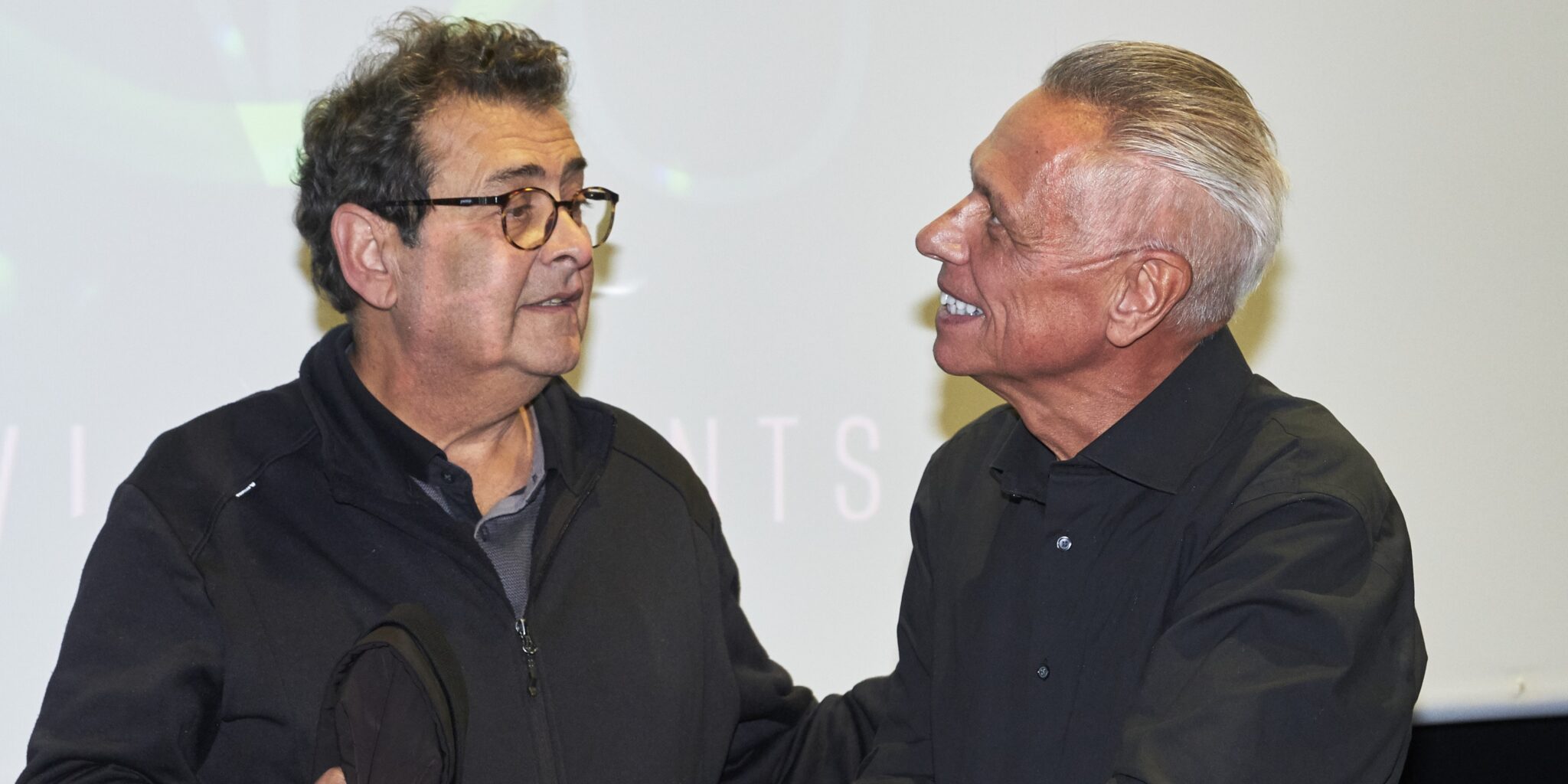
André Bendocchi-Alves greets Gundolf S. Freyermuth shortly after a presentation at the closing lecture of the Transformations Conference, “Playing the Future – in War and Peace,” held on September 25, 2025, in the Cinema Auditorium shared by ifs and CGL, Cologne. Credits: Guido Löhrer.
This post is by Prof. André Bendocchi-Alves, an award-winning film editor and professor who worked closely with Prof. Em. Dr. Gundolf S. Freyermuth at ifs Internationale Filmschule Köln. As a professor of Editing Picture & Sound, coming fundamentally from robust practical experience, André Bendocchi-Alves found in the ideas of his colleague and longtime friend an essential bridge between academic theory and creative praxis. In a bold text that includes a brief concrete poem inspired by the avant-garde Brazilian Concretism movement of the 1950s, André Bendocchi-Alves’s text overflows with deep intellectual and human admiration for Gundolf S. Freyermuth, seen by the author as a personal mentor, fundamental in shaping his own teaching trajectory at ifs.
Check out his contribution below:
Gundolf S. Freyermuth: Thinking the Futures of Today
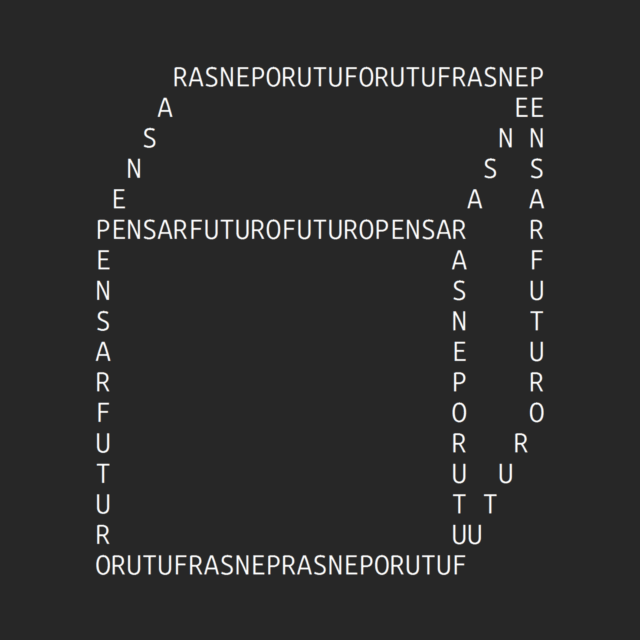
“Futures Thinking Prism”: ASCII art created in a text editor, playing with the Portuguese words “FUTURO” (future) and “PENSAR” (to think). The art work is inspired by the concrete poem “THINK FUTURE, FUTURE THINK,” by André Bendocchi-Alves, which accompanies the main text. ASCII art credit: Pedro Mota.
I hesitated and racked my brain over the desire to write these words.1
On one hand, there was the difficulty of expressing the full meaning of Gundolf’s presence in my trajectory as a “professor-apprentice”; on the other, the challenge of highlighting his importance in the development of ifs Internationale Filmschule Köln.
When I arrived, ifs was, in my view, a work in progress, still without a consolidated theoretical teaching structure. One thing is to study the history of cinematographic language and the development of media; another, quite different, is to learn to think about that process. It was at that moment that Gundolf joined ifs and brought a fundamental premise: the FUTURE is TODAY.
THINK FUTURE
FUTURE THINK
THINK FUTURE
FUTURE THINK
THINK FUTURE
FUTURE THINK
THINK FUTURE
FUTURE THINK2
It is essential to rethink past futures with the FUTURE of TODAY.
Gundolf argued that any creative and innovative process is, in fact, thinking the future in the present. How many times do we work on a future from 20, 30, or 40 years ago without focusing on today’s future? For him, it was essential to rethink past futures through the prismatic lenses of the present. This thought echoed almost like a mantra in his reflections: think the future, and the future think. After all, what would be the role of an educational institution that did not wish to think about tomorrow today?
For Gundolf, thinking the future meant reflecting on today and all the issues of our time. He firmly believed that students entering the Bachelor’s degree in Film at ifs Internationale Filmschule Köln should receive an education grounded in fundamental knowledge of language, philosophy, aesthetics, and history. More than that, the students should confront tools that would enable their thinking and creative development. The film school was not merely supposed to be a portfolio producer or serve solely to supply the economic needs of the market. On the contrary: the market needs innovation.
As a film editing professor coming from practical experience, meeting Gundolf was a gift. He served as inspiration to establish a connection between the until then practice-based curriculum with the theoretical foundations he introduced to the students and me. Sometimes I went to the auditorium to watch his classes and felt I was actively learning from him. Many of my editing classes, as well as indirectly many of our in-class discussions, were inspired by the topics he addressed.
Behind the scenes, we sometimes joked about Gundolf’s quirks. There was the matter of his green tea: if his special tea was missing at school, chaos would ensue! (Crash!!!!) In addition, Gundolf did not accept meetings scheduled before 10 a.m. (to everyone’s happiness).3 I remember once when we went to a Professorenklausurtagung (“faculty retreat”) in a beautiful, isolated place. To Gundolf’s despair, there was no mobile reception and, consequently, no internet connection. Gundolf literally climbed the mountain and turned his phone toward the sky in search of a signal… It was unthinkable for him to be disconnected from the world!
Gundof’s need to stay connected translated directly to his approach in teaching: he played an irreplaceable role in the education of the students. He accompanied countless practical projects, acting as an inspiring mentor whose influence extended past graduation shaping the works of his former students. The spirited debates at school usually revolved around the filmmaking process, and Gundolf would say with his characteristic irony: “There are those who write and those who rewrite,” that is, the Schreiber and the Umschreiber, screenwriters and editors. The rest are Aufnehmer, the people who capture the images. It was a provocative play on words, designed to generate reflection on the filmmaking process and feed endless discussions about collaboration between different departments, reminding us that everyone is, in the end, a CO-AUTHOR.
Despite all this effort, much remained unchanged. The school had difficulties freeing itself from traditional and linear workflows, taking a long time to take advantage of digital tools that enable new forms of departmental cooperation. We experienced together the end of the analog era and shared an enormous desire to change these internal processes at the film school. Cinema is moving images. Shouldn’t filmmakers show the same agility or movement in their own ideas and processes? I still wish that would happen more often.
Later, I followed, even if from a distance, his foray into the field of games. The creation of the Cologne Game Lab was an important step for TH Köln and for himself, allowing him to move forward in time and have a space dedicated to research and the development of his ideas. I confess that, at that moment, I felt a little abandoned, but the innovations continued to live among us in the same building, albeit divided: the CGL is on the second and fourth floor, while we at ifs are on the first and third floor.
I return then to the beginning with the purpose of reaching the end: our students and I carry with us all the fascinating impulses of this great thinker whom we had the privilege of having near us.
As we say in Brazil:
Abraços, querido Gundolf!4
André Bendocchi-Alves
- This text is small and personal, like any other text I would write: a simple gesture of gratitude. ↩︎
- Concrete poem “THINK FUTURE, FUTURE THINK” (in Portuguese, “PENSAR FUTURO, FUTURO PENSAR”), inspired by the ideas of Gundolf S. Freyermuth. ↩︎
- The curriculum meetings (C-Konferenz) without Gundolf’s presence were boring and sleepy. Without him, there would be no interesting conflicts! ↩︎
- “Abraços,” a warm greeting expression from Brazilian culture, translates literally as “Hugs,” meaning something like a “greeting of affectionate hugs”. Adapting the equivalent expression into English would be: “Warm regards, dear Gundolf!” ↩︎