
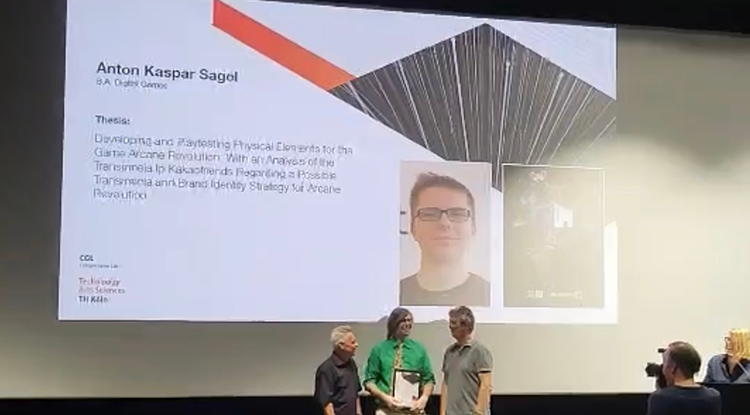
Gundolf S. Freyermuth, Anton Sagel, and Björn Bartholdy at the Graduation Ceremony, 2023. Credits: private.
This post was written by Anton Sagel, a former Bachelor graduate of Prof. Em. Dr. Gundolf S. Freyermuth at Cologne Game Lab, who was his thesis supervisor. Anton Sagel’s creative work is strongly influenced by Gundolf S. Freyermuth’s mentorship. Currently, Anton Sagel is a Master student at the CGL and pursues projects that connect “the digital and analog world”.
Check out his contribution below:
Media Studies as a Basis for Worldbuilding
A retrospective by an alumnus of Gundolf S. Freyermuth
To us students, Prof. Em. Dr. Gundolf S. Freyermuth would always be Gundolf.
The first time I met Gundolf was in summer 2019 during the application interview for the undergraduate program Digital Games. I soon had my first classes with him in the winter semester of 2019. We sat in the Auditorium, as if watching a movie in the cinema. Meanwhile, Gundolf stood on the podium, his Media and Game Studies slides on the huge screen behind him.
In his first session with us, on 25 September 2019, Prof. Freyermuth explained the usefulness of studying game history. He made three main points:
- Learning from mistakes
- Not reinventing the figurative wheel and rediscovering principles
- Knowing the effect of games on culture
Of course, as somebody with an avid interest in history, I could only wholeheartedly agree with the first two points. It was the third point, however, that fascinated me.
As the semester went on, Gundolf taught us about the history of digital games, divided into several “turns”: “Procedural”, “Hyperepic”, “Hyperrealistic” turns, as well as an envisioned “Hyperimmersive” turn, all influenced by and driving technological development.[1]
During the fourth lecture we had with him, on 13 November, Gundolf taught us how the scholarly approach towards games as a medium had developed. He described to us how, at first, research is centred on practitioners trying to improve the creation of games. Then, how scholars from other fields, such as sociology or literature, used games to develop theories for their own field. Lastly, he envisioned how the current schism between scholars and practitioners in the field of games would be bridged. Game studies would rise as a standalone discipline.[2] Bridging this schism was a prominent drive for the foundation of the Cologne Game Lab, as outlined in the Module Catalog B.A. Digital Games:
Graduates of the BA Digital Games should have acquired artistic and academic, methodological, historical, and technical knowledge and skills for the conception and planning, development and production of digital games and other non-linear interactive audiovisual media. […] At the end of their studies, graduates are specialists in either Game Arts, Game Design. […] In addition, graduates should have gained theoretical and historical perspectives as well as artistic and ethical orientations.[3]
In our second and third semesters, Gundolf gave us an overview of media history, from the mechanical and industrial ages to the digital age. Gundolf taught us how throughout history, humans strove to reproduce realistic imagery and how technology developed to meet new aesthetic affordances. In these classes, we read works such as Aristotle’s Poetics,[4] Walter Benjamin’s The Work of Art in the Age of Mechanical Reproduction,[5] Selections from Hegel’s Lectures on Aesthetics,[6] and The New Media Reader.[7] My fascination deepened.
I began wondering: how would media develop in a different society? A society with utterly different technologies? A society utterly different from ours? What aesthetic affordances would such a society have? What if there were not mechanical, industrial and digital ages, but a magical one? I sought to answer these questions through speculative worldbuilding. Accordingly, I turned toward Science Fantasy. “Science Fantasy” describes the fusion of Soft Sci Fi with fantastic elements.[8] In contrast to Hard Sci Fi, Soft Sci Fi focusses on characters, relationships and culture. The natural sciences are not as central to the plot; instead, the social sciences and humanities can be more central.[9]
The process of worldbuilding is shaped by a lens through which the author or designer sees the world and thereby the message or ideology of the piece of media is formed.[10] Media studies became central to my worldbuilding: what if fantastical elements such as telepathy or illusion magic were media in their own right? I further developed these thoughts with the project Arcane Revolution as part of my bachelor’s thesis. It was natural for me to ask Gundolf to be the supervisor for my thesis and graduation project:
The [medieval] world of Arcane Revolution is in the midst of a crass transformative process. Similar to the Industrial or Digital Revolutions of our world, recent scientific developments in the field of magic have a massive impact on the societies of Arcane Revolution. With magic becoming increasingly mainstream, new forms of individual expression and rising productivity promise a bright future. New social groups arise, such as the purple robe workers, profiting from the scientific breakthrough in the arcane sciences. ‘Magification’ is the keyword in the politics of Arcane Revolution; a kingdom might have the best horse-based courier system, but it can never compete if the neighboring kingdom uses teleportation and telepathy.[11]
Therefore, I have to thank Gundolf twice for his vision of bridging the schism between practitioners and scholars in game studies. Firstly, for enabling me to study games in the first place and supporting me in my graduation project. Secondly, for providing me with a view on media history that forms the scholarly core of my world building projects, bridging the schism between research and practice.
[1] Gundolf S. Freyermuth, Games | Game Design | Game Studies: An Introduction (Bielefeld: transcript, 2015), 59–90.
[2] Gundolf S. Freyermuth, Games | Game Design | Game Studies: An Introduction (Bielefeld: transcript, 2015), 191–216.
[3] Cologne Game Lab, TH Köln, “Module Catalog: Digital Games (B.A.),” September 2020, https://colognegamelab.de/wp-content/uploads/2020/09/BA-Digital-Games-Module-Handbook-September-2020.pdf
[4] Aristotle, The Poetics of Aristotle: A Translation by S. H. Butcher, (1895; Project Gutenberg, 2008), https://www.gutenberg.org/files/1974/1974-h/1974-h.htm
[5] Walter Benjamin, “The Work of Art in the Age of Mechanical Reproduction,” in Illuminations, ed. Hannah Arendt, trans. Harry Zohn (New York: Schocken Books, 1969), https://www.marxists.org/reference/subject/philosophy/works/ge/benjamin.htm
[6] G. W. F. Hegel, Selections from Hegel’s Lectures on Aesthetics, trans. Bernard Bosanquet and W. M. Bryant (1905), https://www.marxists.org/reference/archive/hegel/works/ae/index.htm
[7] Noah Wardrip-Fruin and Nick Montfort, eds.,The New Media Reader (Cambridge, MA: MIT Press, 2003).
[8] Kay Moody, “What in the World Is Science Fantasy?,” accessed May 25, 2024, https://kaylmoody.com/science-fantasy/
[9] Kay Moody, “What Is Soft Sci Fi?,” accessed May 25, 2024, https://kaylmoody.com/soft-sci-fi/.
[10] Gundolf S. Freyermuth, Games | Game Design | Game Studies: An Introduction (Bielefeld: transcript, 2015), 174–75.
[11] Anton Sagel, “Developing and Playtesting the Physical Elements of the Game Arcane Revolution; With an Analysis of the Transmedia IP KakaoFriends Regarding a Possible Developing and Playtesting the Physical Elements of the Game Arcane Revolution; With an Analysis of the Transmedia IP KakaoFriends Regarding a Possible Transmedia and Brand Identity Strategy for Arcane Revolution.” (Bachelor’s Thesis, TH Köln – University of Applied Sciences Cologne, 2023).