

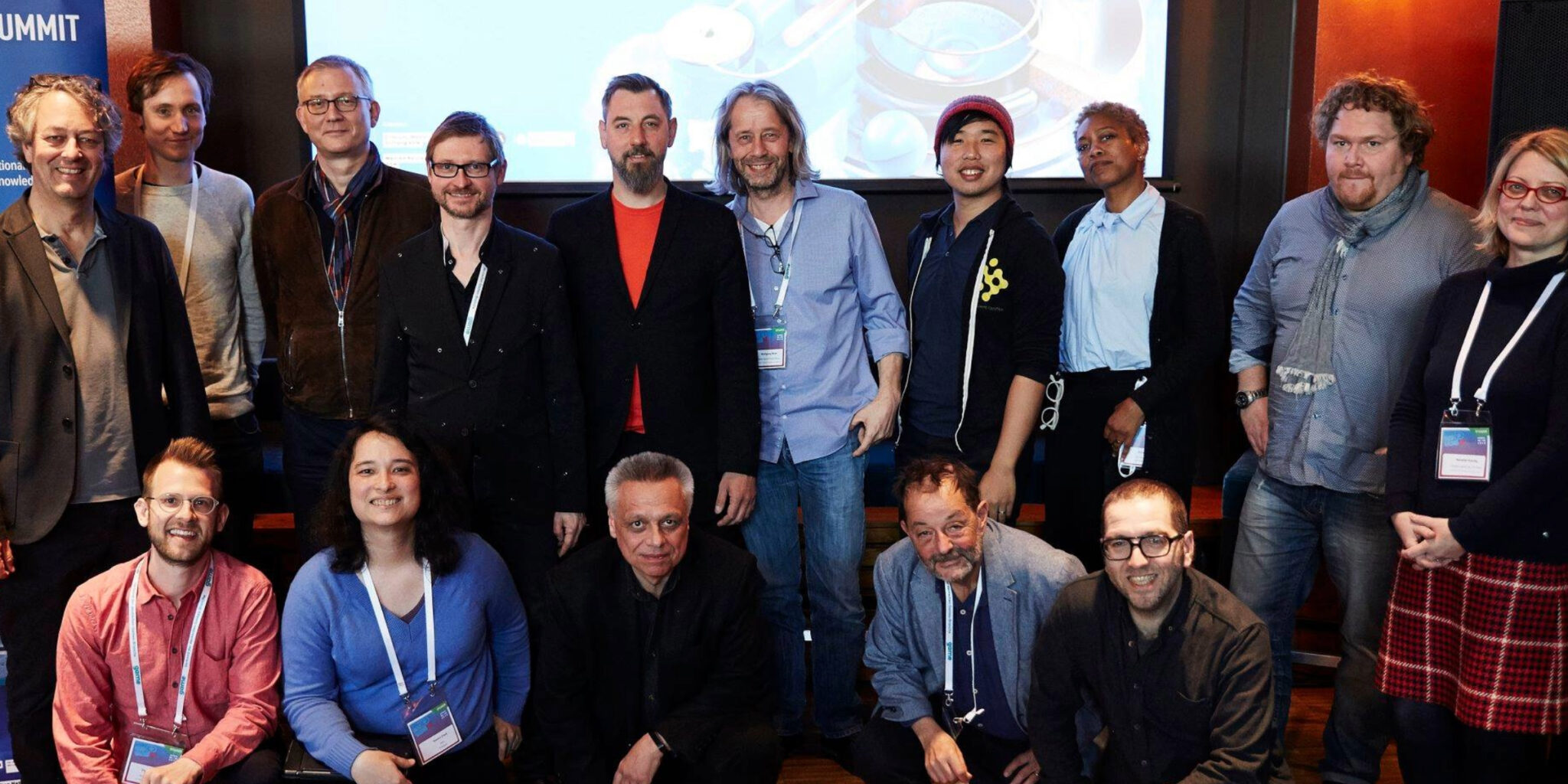
André Czauderna with Gundolf S. Freyermuth and other game educators from Europe and the US at the “Studying Games—Clash of Realities Summit” at QUO VADIS, April 9, 2019, Berlin, Germany (André Czauderna: second from left, back row; Gundolf S. Freyermuth: third from left, front row). Credits: Tobias Pritzl.
Gundolf S. Freyermuth as Curriculum Developer
This post is by Dr. André Czauderna, who has collaborated with Prof. Em. Dr. Gundolf S. Freyermuth for many years at the Cologne Game Lab on the development of game curricula—the topic of the piece below. He is an education researcher with a PhD from Johannes Gutenberg University Mainz. His research interests include educational games, digital games as political education, game design education, learning in online communities of practice, and qualitative methods.
Check out his contribution below:
Gundolf S. Freyermuth as Curriculum Developer
I first encountered Gundolf S. Freyermuth on television. Between 2002 and 2004, he was a regular guest on a program called “Nachtstudio,” discussing topics such as “Conspiracy – The Whole Truth,” “Body – Mind – Machine: Does thinking need a body?,” and “The Return of Utopias?” (featuring the esteemed, late political philosopher Antonio Negri). While this television format now feels like a relic from a bygone era, evoking a certain nostalgia, the themes discussed remain remarkably relevant. They still feel fully contemporary—at times even futuristic—showcasing Gundolf’s visionary thinking, which continues to seem ahead of its time.
A few years later, in 2006, I met Gundolf in person while working at the Institute for Media Research and Media Education at TH Köln. At the time, I organized the first Clash of Realities conference alongside my then boss and mentor, Winfred Kaminski. Our deeper professional collaboration began in 2013, when he and Björn Bartholdy invited me to support their efforts to develop foundational digital games education at the Cologne Game Lab (CGL) of TH Köln.
During the years of working with Gundolf, I learned a great deal from him—perhaps most importantly he taught me how to design game study programs at the intersection of theory and practice. In this post, I will focus on just one aspect of Gundolf’s lasting influence: his advocacy for the humanities as well as for an equilibrium between theory and practice.
In her brilliant novel “Tomorrow, and Tomorrow, and Tomorrow,” Gabrielle Zevin has one of her main characters—an early indie game design superstar—say: “There is a time for any fledgling artist when one’s taste exceeds one’s abilities. The only way to get through this period is to make things anyway.” I don’t think that Gundolf ever saw that imbalance between taste and ability mentioned in the first sentence as a drawback. He believes, I suppose, that having refined taste—and the literacy to critically engage with cultural artifacts—is essential for becoming the best possible game creator. This is why our curriculum places such a strong emphasis on an aesthetic liberal arts education. But at the same time, Gundolf probably agrees with the second part of the quote: it is crucial to start creating as early as possible, even if that means grappling with the challenge of meeting seemingly impossible theoretical standards.
For Gundolf, such a seamless blend of theory and practice goes without saying. The connection between the two runs throughout his entire career—long before he turned his focus to games education. His biography speaks volumes: he has been a film and media scholar for decades, yet he has also applied his theoretical knowledge in his work as a media practitioner—as a journalist, scriptwriter, and novelist, among other professional capacities.
It would be a simplification to associate Gundolf’s contribution to CGL’s degree programs solely with the inclusion of the humanities. In his role as curriculum developer, he must instead be seen as a proponent of theory and practice as two sides of the same coin. In a traditional university literature department, I am certain he would have been among the first to offer applied classes in creative writing—something that remains relatively uncommon in Germany. At CGL, however, the institutional context required him to place stronger emphasis on theory. He became well known for consistently defending the value of theoretical studies in general, and of the humanities in particular, in both internal and public speeches. At the same time, he taught a substantial amount of practical content and supervised numerous projects.
Gundolf’s emphasis on theory becomes clearer when one considers the environment in which CGL operates. Many stakeholders place strong value on practicality, application, and employability. As a university of applied sciences, TH Köln naturally focuses on work-related skill building—a focus that, incidentally, aligns with the current Zeitgeist in higher education more broadly. The games industry demands graduates with highly specialized, ready-to-use skills in specific domains. Some of our students have embraced this trend, becoming preoccupied with mastering particular software packages—sometimes at the expense of deeper reflection and critical engagement with their work. In such a climate, defending the careful study of culture in relation to digital games would hardly have been possible without Gundolf’s exceptional intellect, stoic endurance, and relentless persistence.
Overall, Gundolf’s enduring influence on CGL’s culture and curricula extends far beyond the scope of his own teaching. His vision has been—and continues to be—to educate well-rounded game creators who bring more to the table than advanced artistic and technical skills alone. After all, I believe that the person I first encountered on television more than twenty years ago—in a different time, medium, and context—was already in sync with Gundolf S. Freyermuth, the game curriculum developer: his legacy was implicit in that television persona.